It is no wonder that Princess Poppy doesn’t want to dance with the many potential suitors she meets in the royal exchange program her father and some neighboring kings have devised, but that doesn’t mean she isn’t interested in the handsome prince who promises her friendship . . . and perhaps more. But when the penniless servant Eleanora enters the picture, Poppy must unravel where the other girl gets those fine gowns she wears when she is somehow invited to the ball.
Tuesday, June 1, 2010
Princess of Glass -- Jessica Day George
Despite the fact I wasn’t familiar with the fairytale used as a basis for Princess of the Midnight Ball, I loved that book and have already recommended it to many of my students. This time, youngest sister, Princess Poppy, is back in a tale of her own that is woven into the more familiar Cinderella story which made for a delightful read.
It is no wonder that Princess Poppy doesn’t want to dance with the many potential suitors she meets in the royal exchange program her father and some neighboring kings have devised, but that doesn’t mean she isn’t interested in the handsome prince who promises her friendship . . . and perhaps more. But when the penniless servant Eleanora enters the picture, Poppy must unravel where the other girl gets those fine gowns she wears when she is somehow invited to the ball.
A Season of Gifts - Richard Peck
Watch out readers—Grandma Dowdel is back, and her feisty spirit and creative way of dealing with trouble makers hasn’t gotten old, even though Grandma herself has.
In a story told through the eyes of 12-year-old Bob, the son of the new preacher and his family just moved to town, readers will enjoy yet another series of tales set in 1958 Southern Indiana.
Bob and his parents have plenty of trouble of their own, without adding Grandma Dowdel to the mix. Bob is harassed by a bunch of bullies; his older sister, Phyllis, is obsessed with Elvis, or anyone who might remind her of the King; and his younger sister, Ruth Ann, isn’t quite sure she still believes in Santa Claus, despite Grandma Dowdel’s efforts to offer proof to the contrary.
Like A Long Way from Chicago and A Year Down Yonder, this story will make you laugh, it may make you cry, and it will definitely touch your heart. This one will be a great read aloud for teachers to share with their students and parents will want copies for their own children as well.
Monday, June 22, 2009
The Chosen One - Carol Lynch Williams
Carol Lynch Williams has been known and loved in both the Utah writing community and among readers across the nation since her first book, Kelly and Me, was released in 1995. A multiple-time winner of the Utah Arts Council Original Writing Competition, Nebraska’s Golden Sower Award, and this year’s PEN/Phyllis Naylor Award, Carol has just hit the big-time with her new book, The Chosen One, making last week’s New York Times Editor’s Choice list.
The Chosen One is the story of a 13-year-old girl, Kyra, who has been raised in a polygamist community her whole life, and has just been told by the prophet that she will marry her 60-year-old uncle. Because of her secret visits to the county bookmobile, Kyra knows a little about the outside world and desperately wants to make her own choices in life. Her pleas to her father and the prophet himself go unheeded, so Kyra is faced with choices—does she stay and do as she is told, or does she run away from the only life she has ever known?
I had a chance to interview Carol for my upcoming column in the Spanish Fork Press, but the interview itself was so good, and I could only use a small part of it in the column, so I’m posting the entire interview here so everyone could know the rest of the story.
Lu Ann: I supposed the most obvious question, and one you’ve likely been asked many times before, what brought a “good Mormon girl” to write the story of a girl raised in a polygamous community?
Carol: Oh thank you for thinking I’m a good Mormon girl! I do try to be. I love the Gospel and truly feel like it saved my life. I wrote this story, Lu Ann, because I wanted people to know that members of the Church of Jesus Christ of Latter-day Saints are not polygamists. Upstanding Latter-day Saints do not have more than one spouse. People still think weird things about our religion as a whole. My intention, when I started this book, was that a little LDS girls would meet a polygamous girl and people would see the contrast of the two as the story unfolded. But, as I have said, no Mormons were harmed in the writing of this story! Characters in books have a way of leading the tale. As soon as I penned the first line I realized every thought I had before for this book would have to be thrown out.
Lu Ann: How did your vision or understanding of that community grow or change as you wrote the book?
Carol: I realized that in every community—no matter what kind—religious or not—there can be good, loving people. And people who will try to seize control of others. It doesn’t matter who, what, or where. You see it around the world—and as close as next door. People act the way they are going to—whether they blame God for their choices—or themselves—or their victims.
Lu Ann: I’ve heard that you have a friend, a young man, who left a polygamous community at one time. How did he help you see the inside of the group you intended to portray?
Carol: Chris spoke very little of the community that he lived in. I had just started working on the book when he came to my home that first evening. He was so shy! I told him I was going to write a book about polygamy and asked if I could question him. He said yes. But when I would ask him something, he remained pretty tight-lipped at the time. Things have changed over the years. Now he and I speak openly about his experience. We’re pretty good friends. He’s a great person. Kind and loving and generous.
Lu Ann: Where do you see Kyra’s story going next? Will she meet up with Joshua, regret leaving her family, or learn to survive in the new version of her world? Why or why not? And what do you supposed happened back home with the other children after she is gone?
Carol: Argh! What do you think happened, Lu Ann? That’s a hard question. As far as Joshua—she is only thirteen! And of course she misses her family. I think she will for a long time. Forever, actually. I think she will learn to cope in her new world. She got away from the old one and that took tremendous courage. I know she’ll have help, too. And back home? I can’t even think what’s happening back home.
Lu Ann: Do you anticipate writing another book about Kyra at any time, or about any of the other characters we met in this novel?
Carol: Probably not. But who knows what the future brings? What I have seen from many other writers is that they have a terrific first book and a not-so-good sequel. I don’t want to do that.
Lu Ann: This book seems to be a breakout novel for you. Blurbs from many well-known authors and voices in the YA literature world have given you glowing endorsements. Other than the fact that you are a brilliant writer, as those of us among your longtime fans and friends have known, to what do you attribute this sudden notoriety?
Carol: First, thank you for your sweet comments, Lu Ann. I love you, too! I once asked several different authors what they did to write a successful book. Barbara Williams said, “Write a book about the Titanic before the movie Titanic comes out!” She was kidding—sort of. This book was purchased by St. Martin’s Press two days before the incident in Texas. Just two days. The timing, that I had no control over, has helped to fuel interest in this book, I’m sure. And also, St. Martin’s Press has gotten behind the book. They have wanted to see it succeed. How exciting is that, Lu Ann? You’re a writer. You know how important it is for the publisher to like what you have done. I’ve received this marvelous gift from my publishing house. And I have an editor there, Hope Dellon, whom I adore.
Lu Ann: Have you heard any inkling of nominations or awards pending for The Chosen One? What can you tell us about the PEN/Phyllis Naylor Award you recently won?
Carol: My sweet daughter Kyra is praying that I win every award possible! But, no, I haven’t heard anything except from friends. This is a crazy business. And there are a lot of good titles coming out from a lot of good houses. Kyra has tracked down what she thinks are my biggest competitors and is reading them. “This one, Mom,” she says, holding the book out for me to see, “this one is pretty good. You better read it.” I have a long list of books to read (growing ever longer because of Kyra, thank you very much!). I can’t say I wouldn’t love to win awards. But for sure, I want people to read this book and love it themselves. And the PEN/Phyllis Naylor Award! Wow! That was sooooo cool! I met Phyllis Reynolds Naylor again (I had once many years ago) and sat next to her at dinner. She is wonderful. And I had the chance to meet Lucy Frank (Oy, Joy! and The Homeschool Liberation League—both terrific novels. Really!) who is now a good friend. She was one of the judges and Lucy and I (and two of my girls) spent several hours together when we were in New York for the ceremony. Being with Lucy was like meeting a friend you haven’t seen for a bit. She is beautiful inside and out. My daughters still talk of how generous she was and how they liked her. Anyway, the whole experience was amazing. A real honor.
Lu Ann: You’ve had two books come out in recent months. What new projects are you currently working on? Do you have titles and release dates on future projects or are you still writing them?
Carol: At this point I know I have another book being published with St Martin’s Press. It’s tentatively called Lost in Peace. I have no idea when it will be out. The title will be changed—to what, I’m not sure. It’s the story of a girl who’s caring for her mom—and all the while her mother insists the girl’s dead grandfather is living with them. I also have a book coming out with Paula Wiseman Books called Glimpse. That will be out next summer. It’s the story of a girl whose older sister tries to kill herself. The main character wants to find out why.
Lu Ann: Now that you are seriously giving Stephenie Meyers a run for the money in popularity, what do you most want your readers to know and remember about you and your books?
Carol: Huh?! I don’t think that’s happening. You are so funny, Lu Ann! This is a good question. I want people to remember my character and think she was real. I want my readers to be compassionate to what they don’t understand. I hope they would be willing to fight for those who cannot fight for themselves. I hope they have questions, that they look at the world in a new way, that they love Kyra and her heart. Gosh, I hope I can do those things.
Lu Ann: I’d like to thank Carol for taking the time out of her busy schedule to answers my questions. She just finished a hectic week as one of the organizers for the BYU Symposium on Writing for Young Readers last week, and is now hard at work on her next projects, although she did take some time off this weekend to help her youngest daughter with a cross-stitch project—a butterfly.
Saturday, May 30, 2009
Meet the Dragon Lady: Dragon Slippers by Jessica Day George
As an avid reader, it’s exciting to me when I discover a new author whose books I absolutely loved. That’s what happened not long ago when I read Dragon Flight and Sun and Moon, Ice and Snow both by Utah author Jessica Day George. I had the opportunity to interview Jessica several weeks ago, but because I was a judge in her category for the Whitney Awards I had to wait to even read what I learned about her from the online interview. Since then, Jessica has released a new book in the Dragon series, Dragon Spear, and a retold fairy tale, Princess of the Midnight Ball, both books I’m excited to read.
I met Jessica at the Whitney Award Gala and I discovered, she’s not really a dragon lady, but she loves to write about them. Dragon Slippers was the first children's book she had ever written, and it ended up being the first book she had published. “My first six books are still languishing on my hard drive!” she says.
She says her publication story is a matter of being in the “right place at the right time. I went to BYU's Writing For Young Readers Conference, and during the Saturday morning pitch session I just happened to sit next to a girl who was setting up a small, by invitation only, workshop with Melanie Cecka of Bloomsbury as the guest of honor. I got to spend fifteen minutes talking to Melanie one-on-one, and she loved not only Dragon Slippers, but other ideas I threw at her as well.”
About her newest book, Dragon Spear, she says, it “will be the last adventure with Creel and Shardas, but I will definitely be going back to Feravel some day.”
Although Dragon Slippers, and the resulting series which included Dragon Flight, got her career off the ground, it’s her Norse folktale that makes her stand out from the crowd, ending up as a Whitney finalist in both Youth Fiction and for Novel of the Year. A longtime fan of Norse folk tales, regarding another book along those lines in the future, Jessica says, “I'm toying with several ideas, actually. I love writing about Norway! I might do a historical fiction with Vikings, I might take on another folk tale. We shall see. . . .”
Since I spend most of my time with seventh grade students, a perfect audience for her books, I asked Jessica why readers should pick up one of her books to read. “Because I try to write books that I would enjoy reading,” she says. “I like to have lots of humor, but also lots of fun characters and some good action thrown in as well.”
An avid reader herself as a teen, Jessica says her favorite books were “ANYTHING by Robin McKinley! With Diana Wynne Jones as a close second!” She has continued to write for this audience herself because “the ideas just kept coming! I've always been a huge fan of YA fantasy, and after writing six adult books, I suddenly (or should I say: finally) started getting idea after idea for YA and middle grade books.”
For those who might want to become writers themselves, Jessica says, “Never give up, never surrender! Just keep writing, and keep looking for opportunities to meet with editors, and it will happen.” But even once you’ve sold your book, the job of writing isn’t over. “No matter how much she says she loves your book,” Jessica adds, “your editor will find bajillions of things that need ‘work.’ Don't give up, and don't hyperventilate, just do it.”
Good advice for us all, but if you’ll excuse me now, I have two brand new books from one of my new favorite authors waiting for me on my bookshelf.
Saturday, October 11, 2008
Pretty Like Us - Carol Lynch Williams
From the very first novel I read by author Carol Lynch Williams, I have been a huge fan of both the author and her works. That’s why I was excited to not only read her latest novel, Pretty Like Us, but also to have the opportunity to interview her.
Pretty Like Us is the story of two girls—Beauty McElwrath and Alane Shriver. Beauty, a painfully shy sixth-grader, lives in a small town in Florida with her mother and grandmother, both strong-minded single women. Beauty wants to come out of her shell and make friends, but her efforts have always resulted in teasing from the other kids at school. The fact that her mother is dating her teacher doesn’t help matters at all, and Beauty is certain she is destined to always be a social outcast.
Then Alane moves into town. Before the girl even arrives in class, Beauty’s teacher has asked the students to be kind to the new girl who suffers from a rare disease known as progreria, an aging disease. When Beauty first sees Alane, she thinks there has been a mistake. Surely this is Alane’s grandmother, not the girl herself. No one in sixth grade could look that old.
But it is Alane, and she sits right next to Beauty. Just what Beauty thinks she doesn’t need to help her get over her shyness and absence of friends, until she starts to discover that beauty of often more than skin deep, and true friendship sometimes comes in odd packages.
This is truly a must read book for girls. Those who are shy will relate to Beauty, just as those who see themselves as different will relate to both girls. All girls have felt concern over being accepted at some time in their life, and Beauty and Alane’s story will not only let them see themselves, but will also give them lots of laughs along the way.
I'm always fascinated by the names Carol Lynch Williams gives her characters because they are truly unique, so I asked her where they come from. “There’s almost always a name in a book that I’ve written that belongs to a person I know,” she says. “For me, it’s a way to say I love that individual. In Pretty Like Us I had decided I would name one of the character’s after my very good friend Alane Ferguson. She’s a fellow writer—a mystery writer—and a terrific person. It turned out that Alane’s name actually means beautiful one—and so it fits right into plot of my novel. And by the way—Beauty’s name started out Grace Beauty. When I sold Pretty Like Us, I also sold a series another writer friend and I wrote with characters named George and Gracie. And you guessed it. I know someone named Grace—that’s my youngest daughter’s middle name!”
I was also interested in Carol’s choice of using Progeria in a middle grade novel. The disease is so rare, I didn’t know how kids would relate to it. “When I was young,” she said, “I met a girl who may have had Progeria. She was nearly blind and looked old—way too old to be ten or eleven. I haven’t forgotten how that little girl pulled out a magnifying glass to read. I was struck right in the heart at that moment. I still remember the incident—everything that was going on at the time. The event remained with me for many years, as well as wondering how this girl existed when children can be so cruel. So I did what writers do, I wrote about her.”
Like all good writers, Carol knew she had to do more than just create a story; she also had an obligation to make the story ring true. “Rather than just seeing the physical differences, I hope people see the similarities they have with these individuals. Like Alane wanting to be a writer, children with Progeria have goals and dreams, too. They are loved and when they die, they are missed.”
I wondered about the prognosis of children who suffer from Progeria, and Carol tells me, “At this point, the disease is always fatal, though children might live longer than twelve or thirteen years old. But there is good news—scientists have found the link between those with Progeria recently. This was hard to do because there are so few cases in the world at the same time. Many times, a child will die very young. You can ‘meet’ some wonderful families with children who have Progeria by researching on the web, like I did.”
Anyone who has ever tried to write a story knows that some parts come easy, and others are really hard. Carol says, “This novel came to me in spurts—based on several true events. There was the young girl I met when I was younger, but this story is also inspired by a woman I met at a local university, who at 45 was a grandmother already—and by a tornado in Texas. The hardest part about writing Pretty Like Us was that when I drafted this book the first time there were actually two stories in one. Once I was able to separate them, and make them both distinct, I was able to sell them both.”
When it comes to writing, Carol is an expert and a great teacher. I was curious about where she starts. “I almost always start stories with a character and an incident,” she explains. “So I kind of have this core knowledge of them as I tell the story. But my characters begin to come to life for me as I write and rewrite, as I discover who they are and what makes them tick. I’m usually exploring main characters even after many rewrites. Rarely does a character spring fully formed from my head—though there is the core of that “person.” And she’s usually interesting enough that I want to follow her for 150 or so pages.”
New writers always want advice about where to start. Carol says, “Write, write, write. And read, read, read. Join a critique group that will help you improve as a writer. Don’t believe what you have written has come from God—and know that your words can be changed if they aren’t working.”
If there were one thing she would advise the newly published, something she wishes she had known with her own first book, it would be, “A good book needs to have some push—or marketing— behind it, and that won’t come from the publisher. There are lots of good books out there that never get the marketing they need. We, as writers, need to help our books along. But, we as writers tend to be quiet and reserved. We don’t all know how to promote ourselves!”
Taking her own advice about reading, Carol is an avid reader. “When I was a kid,” she says, “I was reading adult novels. It wasn’t until I realized I was a mid-grade/young adult author that I started reading books for younger readers. So from 12 on I read the greats—like John Steinbeck, William Faulkner, Mark Twain, Flannery O’Connor, and Eudora Welty. Before that I read a lot of poetry (my mother was an English major—and became an English teacher!) and non-fiction. I am still fascinated by bees and the parts of flowers. I do remember being about 10 and being thrilled when I found out that L. Frank Baum had written an entire series based on The Wizard of Oz.”
Carol says she hopes readers find her books fun, and I believe they do. “Many times my books have characters experiencing tough situations—and living though them—mostly,” she says. “Books are a great way for readers to do something they’ve never done before. Another reason to read my novels is because Jim Jacobs—one of the men who’s helped shaped children literature—says I have a true middle grade voice. So there.”
And I’ll add my vote to that comment as well. Carol truly does have a great talent for finding the true voice of middle grade characters and bringing them to life in a funny, interesting, and believable way that will touch reader’s hearts and their funny bones as well.
Tuesday, September 2, 2008
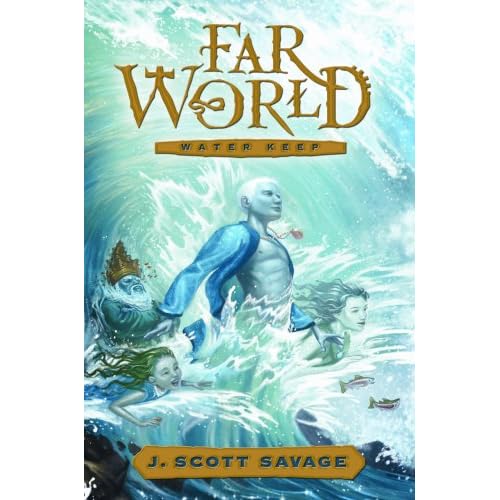
Farworld: Water Keep by J. Scott Savage
Six years ago a new member joined my writer’s critique group. Back then his name was Jeff Savage, and he only had one published book, Cutting Edge from Covenant Books. I’ll admit, I gave him a hard time on that one. It was a great story, but there were things about the writing that just bugged me, and if anyone has been a regular reader of my columns and reviews, you’ll know when something bugs me, I’m sure to let people know.
Today I’m happy to say, that Jeff’s (okay, J. Scott’s for this one) writing has improved, and his storytelling has become spectacular (listen to the jealousy and pride in my voice). Many a night I have come home from a late meeting of critique and not been able to sleep because of some scary scene that Jeff read from his latest horror novel, or I’ve found myself jumping at some noise because his latest Shandra Covington book had me seeing the boogie man around every corner.
This time though, we didn’t really have to worry about bad things that go bump in the night—well, there is the Thrathkin S’Bae, Bonesplitter, and the Dark Circle, but Kyja and Marcus can handle them. After all, this is young adult fantasy, and like Harry Potter and his friends, these two likable protagonists should be able to handle anything, especially since we know there are more books to come in this five book series.
Farworld is the story of a girl, Kyja, who wishes she had the use of magic in a world filled with spells, charms, and potions; and Marcus, a crippled boy who escapes his cruel surroundings by dreaming about another world. Together they take on the Dark Circle, prepared to keep Master Therapass’s secret and protect Farworld, while seeking the Elementals, and convince them to open a draft between the both worlds that will save both the children’s lives.
Because I know Jeff so well–and because I didn’t want to embarrass him too badly—I’ve asked him a few questions to let all of you know more about both his book and its author.
1. You know all your readers love that little ishkabiddle. What is your take on the reason why and why was that single scene at the beginning so surprising to you?
Well first of all, the ishkabiddle was a last minute throw-in. It was originally just a rabbit. But I needed the reader to understand we were not on Earth. But I guess it shouldn’t surprise me that the ishkabiddle became such a hit. One of the first rules of writing a thriller is to put an innocent in peril. And what is more innocent than a funny mother animal with cool little spinning thingies that come out of her feelers?
2. I've always wondered, did you write about the scenes where Marcus is being bullied so clearly because you were the bully or the recipient as a child?
I was bullied like you wouldn’t believe. But that’s probably what pushed me into reading, which in turn pushed me into writing. So, thanks—jerks! Plus I got some good advice on the initial dialog for an amazing writer who shall remained unnamed. Lu Ann.
3. You're committed to a five book series, and I would imagine Shadow Mountain intends that to extend over a period of five years. How do you, as an author, think you will be able to keep your momentum going for the series? Do you plan to write more than one "episode" each year or to wait and write them a book (and a publication year) at a time?
I will write more than one book a year, but not in this series. For me, at least, the story needs to stay fresh. When I’m writing a book, it’s the coolest story ever. But it’s hard to keep that enthusiasm once you are done writing. I’d hate to write all five books now and be bored out of my skull with the series by the time the last book comes out. The nice thing about this series is there is a clear progression in my mind. I know about the cool things that will build in each book. It’s not like, “Sammy goes to school,” “Sammy makes a friend,” “Sammy goes to prison.”
4. I hear you're planning a nationwide motor home book tour. That says to me you're planning to make enough money to pay for the gas (tee hee!) What fabulous cities do you plan to visit and will the school and bookstore visits also allow you enough time for sight-seeing?
Well. It can’t happen until book two at the earliest, and probably book three. But my wife and I would like to take our youngest boys on an RV tour of all 48 states. I would do school tours three days a week. We’d travel one day and week. And the rest of the time would be spent exploring this amazing country. I think it would be a one-in-a-lifetime chance for all of us.
5. I know you well enough to know you write fast and frequent, what do you plan to work on to keep your writing habit flowing freely between the segments of Farworld?
Yeah. I’m the ADHD author. I’ve got tons of other ideas. I’ll still keep my mystery series going, of course. But I’m also really excited about a series where a hit man/PI gets sent to hell and has to earn his way out. Kind of an urban fantasy with cool magic and weapons.
6. You've had a successful run as an author in a local niche market. What changes---both positive and negative---do you anticipate as you move into the national fantasy arena?
From a positive side, suddenly the whole world is your oyster. It’s great to be a bale to drop into a bookstore in Boston and say, “So do you have my book on order?” I even had a book ordered from Amazon.UK the other day. How cool is that? Plus I really like hearing from people who have never read a book by me before. I think it’s the truest test of whether your writing is any good when someone just picks your book off a shelf with no idea of who you are. On the other side of the coin, you’re swimming in deep water now. You can’t just be as good as the other regional authors. You’ve got to be as good as the big boys and girls or people will not try you again. It’s a challenge, but I think every author wants a chance to compete with the best.
7. What are five pieces of advice you've learned from other authors that you wish you had listened to more carefully?
I actually listen pretty carefully. I value the insights of other authors a lot. The problem is I didn’t really talk to any authors before writing my first book. But here are some good pieces of advice I’ve received:
★ Don’t quit your day job.
★ Find a good critique group.
★ Understand what each POV buys you and choose carefully.
★ Write for kids instead of to kids.
★ Don’t use back and that so much.
8. What are five pieces of advice you'd now share with other authors, now that you're among the ranks of those publishing?
Other than the whole SASE and prologue debates?
★ Don’t waste the first page. That’s where you win or lose your readers.
★ Avoid flashbacks unless they are absolutely vital.
★ Don’t break the rules of good writing unless you really understand them. (The first time you think you understand them, you don’t.)
★ Write because you love to, not to be published. That way, you’ll enjoy writing no matter what, and when you do get published it will be icing on the cake.
★ Don’t ask for feedback on your writing unless you are prepared to throw out anything and everything that doesn’t work. A good writer learns not to be defensive.
9. How does your wife really feel about you hanging out with the "Ladies of Wednesday night"?
Well at first, she was a little jealous about me spending one night a week with six beautiful women. But once she met them and saw that they are great people, she was totally cool with it. Plus I’m not real fond of pizza so she and the kids make that their pizza night.
10. Come on, we all know there's one question you've been dying to answer, but that none of us have been astute enough yet to ask you. What is it? And what would be your answer?
Hmm. How about, “Did you ever take a girl on such an incredibly creative date that even after she got married she said it was the best date she ever went on?” Answer yes. “Did she kiss you good night?” Nope. She totally blew me off.
11. Tell everyone one more time, just how important was I to the final process of your getting this book published and in having such great discussion questions at the end.
I hereby testify that without Lu Ann’s incredibleness Farworld would never have happened!!
And without Jeff (Scott) as a member of my writing group, I wouldn’t have gotten as far myself as a writer or an editor. I think you’ll all love Farworld, and I hope everyone who reads this book goes out and buys a copy. Of course, maybe I am biased. (Having my name in the Acknowledgment section of a nationally published book is a little heady—see page 419.) But it sure is nice to see such a nice guy make it good in the book market.
If you’d like to know more about Jeff, or just hear what his voice sounds like, listen to the podcast I did with him Saturday, April 28, 2007, by going to my blog for that day titled “It's a Techno-World, After All!” and clicking on the podcast icon.
If you'd like to win an advanced reader's copy (ARC) of Farworld, listen to the podcast and correctly answer this question in a reply to this post on either of my blogs. He gives the answer during the podcast, so only that answer will do. I'll draw a winner from all correct answers on Tuesday, September 9, 2008. Good luck.
The trivia question is: "What is one of Jeff's favorite things to do?"
To buy a copy of Farworld, visit here:
Tuesday, June 10, 2008
The 13th Reality: The Journal of Curious Letters - James Dashner
Fantasy or not, Dashner has set his book in reality, researching both quantum physics and locations for this first book in the series. “I had never been to the place in which it begins, Deer Park, Washington,” he says. Perhaps influenced by his own favorite series, The Chronicles of Thomas Covenant by Stephen R. Donaldson, Dashner allows himself, and his main character, to delve into the alternate worlds that Thomas Covenant dared not believe in, despite the fact he suddenly found himself there to fight for that land, and to be the reincarnation of its greatest hero, and The 13th Reality Book 2 will be no different. James adds, “The Hunt for Dark Infinity is in the editing stage. It was a lot of fun for me because I was mostly done with the setup. It jumps right into action and other alternate realities.”
Readers should pick up The Journal of Curious Letters because, as Dashner himself states, it is “unique, fast-paced, full of riddles and plot twists, some humor, kick-butt ending. I'm biased, however! It has gotten some excellent reviews from the likes of Kirkus and the Chicago Sun-Times.” And also excellent reviews from the students of Payson Jr. High School who read it this year in their 7th and 9th grade English classes. As a matter of fact, many of those students also got to read the early draft of The Hunt for Dark Infinity and are now anxious for James to write Book 3.
The 13th Reality is not the first book James Dashner has published. An earlier series, The Jimmy Fincher Saga is also still available from Cedar Fort. But Dashner feels he has grown as a writer since he published his very first book. “Hopefully I'm a much better writer now, and boy would I love to give my first four books a nice revision—all the technical writing skills I’ve learned since then.”
As most writers know, not every book that is written actually gets published. When asked about his unpublished novels, James says, “There are only two, and one is undergoing a major rewrite while my agent tries to sell it on proposal. This one—The Maze Runner—is at ten publishers as we speak. Keep those fingers crossed! The other one, I doubt it. In fact, I've cannibalized it for other ideas, not the least of which is the name used in The 13th Reality: Atticus Higginbottom.”
But how can budding authors break into the business? James says, “Practice. Write a lot. No matter how bad it comes out, keep writing. Also, attend every writer's conference you can possibly afford to. The things you learn and the networking you accomplish are invaluable.” Speaking of networking and getting people to know about your book, he adds that “networking is by far the best route to go. You need to get to those conferences and meet agents and editors face-to-face.” Advice that couldn’t be more true if you want to be a writer.
But, even if you’re just a reader looking for a book that is fun, exciting, and appropriate for both you and your family, The 13th Reality: The Journal of Curious Letters is the book for you.
Subscribe to:
Posts (Atom)